Tuesday, September 28, 2021

Dark Continent 2

Finally some information! 

Issue 5 of SPFX contains a wealth of information on rare stop motion films, including several prehistoric films that never got made. 

Among these are brand new info plus stills from the mysterious Sherlock Holmes in Africa movie "Dark Continent," featuring a surviving arsinotherium, about which I could find literally nothing about online. 

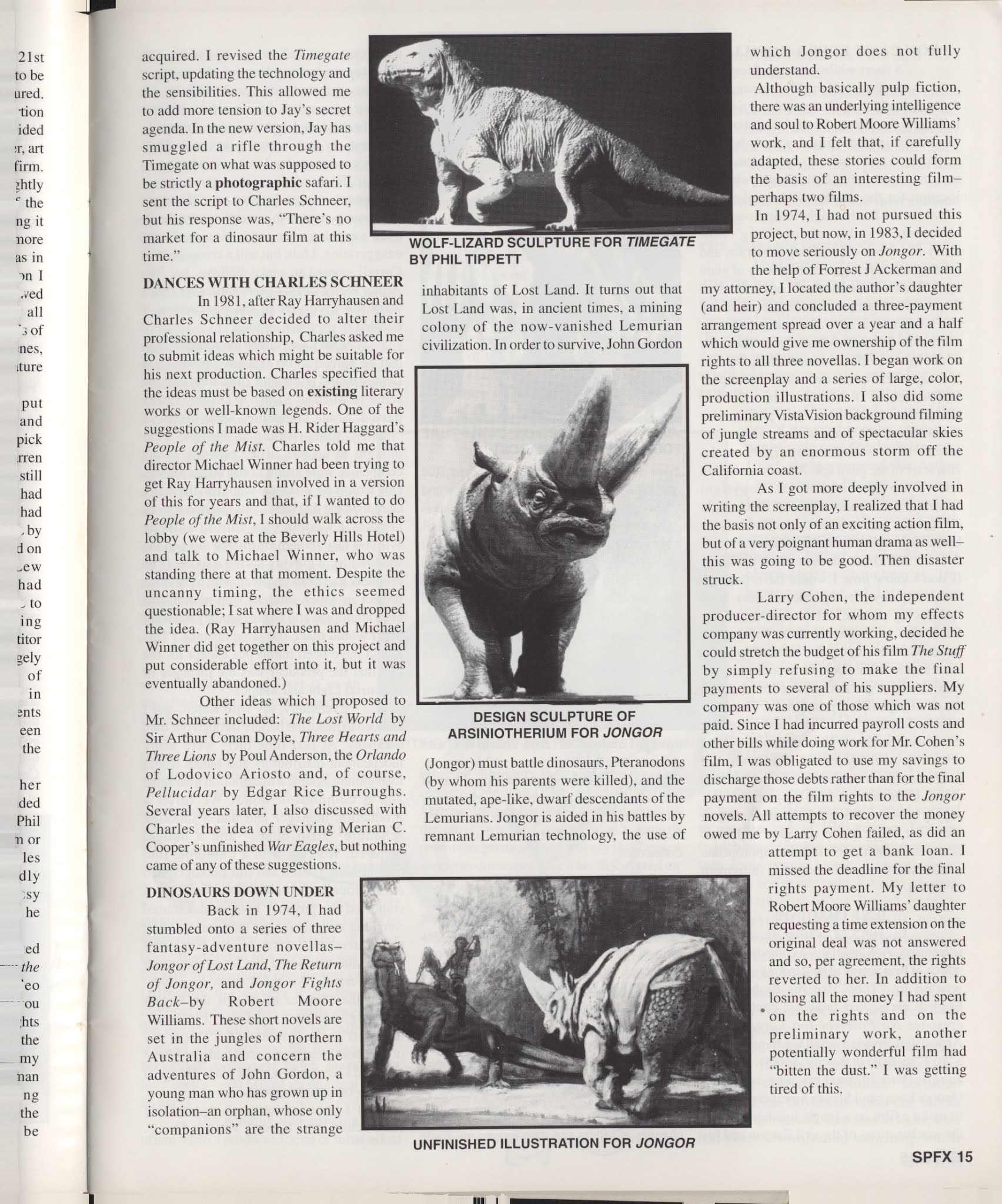
In an article by Jin Danforth, one of the pioneers of stop-motion animation, he discusses a number of his proposed film projects, including a film version of "Jongor of Lost Land." A series of pulp novels about the hero, Jongor, abandoned in a lost world in Australia, that was once an Atlantean colony. The movie was supposed to have included an arsinothere, which is slightly patterned on the living Indian rhinoceras, as you can see by the folds of skin: 

He then goes on to describe "West of Kashmir" a proposed script for a Sherlock Holmes film involving Holmes antagonist Col. Sebastian Moran, who discovered a giant snow-ape high in the Himalayas, and somehow disgraced himself. The story was about Holmes and Watson teaming up with a beautiful Anglo-Indian woman who was a former lover of Col. Moran, traveling to the the Himalayas and encountering the creatures while attempting to bring Moran to justice. 


"Dark Continent" was supposed to be a sequel to "West of Kashmir." It is a most intriguing tale. The story has Holmes and Watson traveling to Africa where they meet up with Ayesha, the ageless beauty from H. Rider Haggard's She. That's right, it was to be a cross over between the writings of Conan Doyle and Haggard! How does the Arsinotherium fit in? Well, in Haggard's original, there were no prehistoric fauna (if there were, I would have known about it). But there are in Danforth's version, and he doesn't just "cheat" by inserting them in. Just as Asheya herself is kept ageless by the Eternel Flame of Kor, so are certain survivors of the prehistoric ages kept alive. There are two others besides the aforementioned arsinothere. And here is where things really get really interesting. Years ago, in some documentary about dinosaur stop-motion--it seems like it was hosted by Donald F. Glut, but I might have been wrong--there was a briefly shown glimpse of an animated clip of a strange theropod dinosaur which resembled a cross between a spinosaurus and ceratosaurus. It had the fin-back of the former and the horned snout of the latter. This was back when spinosaurus was assumed to be a kind of generic theropod, like an allosaurus or megalosaurus, only with a fin. Where this clip originated, I had no idea, and never found out--until now. It was the spinosaurus already animated for its appearance in "Dark Continent." The one other prehistoric beast was a giant serpent (titanoboa?) which was to battle the spino:


Of course, it is such shame that these movies never saw the light of day, save in these stills, and that one clip of the spino, wherever it was I saw it. I leave you with one last (aforeseen) shot of the arsinothere, which may well be the same model for the Jongor film, given the rhino-like patterning. 

Friday, November 13, 2015

The Dark Continent


This was going to a post regarding a mysterious "proposed" Sherlock Holmes movie, from the 60s or 70s, to be set in Africa, and featuring prehsitoric creatures. I could find nothing about this on the web, however.

I did find this post, however, about Holmes tales set in Africa. The blog, "Sherlock Holmes: The Golden Years,"is a good site on Holmes and Conan Doyle, and worth checking out:

http://sherlockholmes-thegoldenyears.blogspot.com/2015/08/sherlock-holmes-in-dark-continent.html

The Maple White Terror


This is basically to promote my book, available from Amazon.com, titled The Maple White Terror:

 http://www.amazon.com/The-Maple-White-Terror-Adventure/dp/1514333791


It is indeed a Holmes pastiche, but it is also a Lost World pastiche, which invloves Holmes and professor Challenger interacting. Much of it involves reporter Edward Malone (of the Lost World) fresh from a new expedition to the dinosaur-ridden plateau of Maple White Land, and the new wonders and horrors uncovered there. What do they have to do with a recent grisly murder in London, not far from the British Museum of Natural History?

Tim Lebbon's "Horror of the Many Faces"


     The last post I did here was in regard to Micheal Dibdin's rather infamous The Last Sherlock Holmes Story, and also, my attempt to counter it with a short story of my own.

    There is one other story (that I'm familiar with) that attempts something similar to Dibdin's story ( don't read the fourth paragrpah here, if you don't want  read SPOILERS for that tale!), and which does include the satisfying double twist that Dibdin's story lacks.

     That tale is to be found in a collection of wierd fiction I've had for some years now, called Shadows over Baker Street. This is an anthology of tales that pit Holmes and Watson against wierd menaces inspired by the horror of H. P. Lovecraft. Unlike all the tales in the canon, here the bizarre nature of crimes has no "rational" explanation. Among the best herein are a tale in which Moriarty gets his hands on the Necromonican (narrated by Moriaty himself on a phonograph!), and "A Study in Emerald" by Nial Gaiman, involving an alternate reality, in which the roles of Holmes and Moriarty are reversed.

   My favorite tale in the bunch, however, is "Horror of the Many Faces,"by horror veteran Tim Lebbon. The story hooks the reader from the very first sentence, and , beleive me, doesn't let go until the last page, by which time the reader should be wrung dry. The story opens with Watson witnessing the same type of dreadful scenario that occurs half-way through Dibdin's novel; in other words, he beholds none other than his trusted, lifelong friend, Sherlock Holmes, in the act of eviscerting a freshing slaughtered corpse.

     What Watson first suspects, naturally, is that his friend has gone tragically insane.  When other reports come in around London involving the same manner of killings, each one witnesed by friends and realtives of the killer(s), Watson assumes Holmes is responsible for all of them; he's a master of disguise, after all. As might be expected, of course, Watson misses an obvious question as to why "Holmes" did not bother to disguise himself the first time, when none other than his best friend was able to identify him.
  
     This being weird fiction, of course, the reader can guess that the cultprit is likely to be something other than a mere master of disguise or a madman. I won't spoil the ending for this one, but suffice to say that the great detective is left distrubed and brooiding over the fact that there are some things beyond the ability of even his mighty intellect to solve; secrets that, in fact, lie beyond the ability of human comprehension.

    Definitely a thought-provoking short tale, and worth a read, especialy on a dark, blustery November night.

Friday, October 23, 2015

The Last Sherlock Holmes Story and The Napoleon of Crime


For years I've heard and read of Micheal Dibdin's rather infamous Sherlock Holmes pastiche, The Last Sherlock Holmes Story. Some time ago, I actually did read the story in an online PDF. This is story that Holmes fans tend to either love or hate. There is a monstrous twist half-way through the tale, that I won't give away here, which left Holmes fans (understandably) mortified. Though I knew what the twist was, and was not really offended, I generally do not like pessimistic or downbeat endings. Some reviewers have complained on the lack of a "double-twist" at the end.
   This is why I wrote that story "the Napolean of Crime," with it's obvious reference to Moriarty. The scenario is similar, though not identical to Dibdin's, only with the twist that he did not supply. A "rebuke" if you will.


Truth be told, since my previous book, The Maple White Terror, happened to be set in a "Doyle Universe," in which not only Holmes and Professor Challenger meet and interact, but references to other stories occur. There were three Challenger stories written by ACD, The Lost World, The Poison BeltThe Land of Mist, and When the World Screamed. All of them qualify as science fiction, placing ACD in the same category as Jules Verne as a pioneer of the genre, except for Mist. This was a tale which basically promoted the "science" of Spiritualism, in which Doyle was infatuated, and featuring Challenger as a reluctant convert. When writing the climax to The Napoleon of Crime I included a reference to Land of Mist, but after reading John Lavas's explanation of it online, I decided to leave it out, which is a bit of a same; I wanted the "shared universe" concept to be evident. Why did I leave it out? It seems that Doyle wanted his popular characters from The Lost World to star in it, but wanted it set in the "real world," or something like that, so he deliberated created inconsistencies, such as the suggestion that Edward Malone's published accounts of both The Lost World and The Poison Belt were false.

Arthur Conan Doyle's (Non)Vampire Stories

This is a fairly recent anthology of ACD's wierd fiction that I read recently.

     Reader be warned: The stories contained herein, with the possible exception fo the three Holmes tales, do indeed qualify as weird fiction. There just isn't even a single true vampire tale in the bunch, at least in the tradtional sense. I checked the reviews for this over on Amazon to see if I'd missed something, but nope, everyone seems to agree the title is basically a fraud, even though the stories themselves aren't bad, and in fact they're a good small sampling of ACD's supernatural fiction. It seems certain then, that ACD, even though he was acquainted and influenced by Bram Stoker, never wrote vampire fiction (that we know of).

    Each tale, however, comes with an afterward that attempts to "justify" it as a vampire story.

    To wit: "The American's Tale," is actually about a giant carnivorous, or perhaps "hemovorous" plant. It's a plant that sucks blood, so therefore it's a "vampire tale." Get it?

      "The Captain of the Polestar", is mentioned on the blurb as being a tale of a "heat-sucking Eskimo Vampire." This story is included in two other anthologies Iv'e read. The most obvious interpretation is that the entity in question is a ghost that spells the death of the captain at the end, though in fact, this is never established, and given what information we have, it might indeed have been an Eskimo vampire. But it's pretty much up to reader interpretation.

     "The Parasite" is a frightening tale involving hypnotism, and a woman who is able to literally take over and control the minds of her victims. I doubt she could be considered in any sense a vampire though, even if the title somewhat suggests this.

     "The Winning Shot," is about a group of young friends who encounter a mysterious stranger in the country.;the man has a dark though charismatic persona, and does seem to have somewhat suggestive of a vampire, including supernatural abilites that are not established until the end. This story is noteworthy in that it is a rare tale in which the bad guy actually wins. Doyle is quoted as describing this story as "'a vampirey'" little tale." But there is nothing to suggest that the villain is vampiric in a literal sense; he is even up and about in the daytime!

     I'm not too certain why the Holmes story "The Illustrious Client," was included here. The other canonical Holmes tale, "The Adventure of the Sussex Vampire," has its obvious vampiric connections, but, as with the case of all stories in the Holmes canon, there is no true supernatural element. In fact, Holmes famously debunks the need for supernatural explanations early in the story. The tale is also rather famous for mention of "The Giant Rat of Sumatra," a tale in Watson's files that he informs the reader,"the world was not ready for." A number of pasthiche writers have written speculative accounts of just what that adventure might have been.

     The final tale is a pastiche, "The Case of the Vanished Vampire" by Bill Crider not ACD at all, and therefore not canonical.It at first seems to be a team-up between Holmes and Watson and Van Helsing, Bram Stoker's famous vampire hunter. This has been done before, but all is not quite as it seems here. In any event, POSSIBLE SPOILER AHEAD, the story sticks to the canonical tradtion in that there is no actual supernatural theme here, and thus no true vampire.
   
    All in all, a decent collection of weird fiction with a misleading title.

Friday, October 16, 2015

Horror of the Heights and Other Strange Tales

Horror of the Heights and Other Strange Tales is a collection of the famed author's weird fiction. I've read a number of the tales therein in a previous collection of Doyle's horror tales, but it was a treat to them again.

    Among my favorites to be found here are:

 "The Brazilian Cat," featuring a strange crytozoological felid, which appears to be neither puma nor jaguar, cats both native to the region;


"Lot 249," about a student of Egyptology who is able to bring a mummy to life to do his evil bidding (Note: Tales of the Darkside: the Movie did an updated version of this, which took many liberties, which I've been familiar with for years. It's pretty much standard horror; they should have at least set the story in Victorian London to preserve the original gaslit feel of the story. I was also surprised to read in the original that Bellingham, the student, is actually obese in Doyle's version, while the actor who played him in the movie was thin); "The Parasite," the tale of a woman with terrifying powers of mind control; "The Brown Hand," one of Doyle's few actual ghost stories; and Horror of the Heights, the title story, and a science fiction tale that speculates. on the weird lifeforms that might actually thrive in the upper atmosphere of our won planet.

    That might actually have seemed rather credible back when Doyle was writing, as aeronautics was still a new field, and planes themselves were rare. The field of bulbous, jellyfish-like ariel floaters the size of buildings, which the narrator encounters, somewhat reminded me of an old episode of Carl Sagan's Cosmos I watched as a child. That episode featured possible lifeforms that could theoretically inhabit the dense atmosphere of Jupiter: massive "floaters," --"creatures the size of cities" in Sagan's words.  he explained that there might also be hunters-winged predators that prey on the floaters.

   Doyle's floaters also have their predator ---a creature that remains aloft be means of a natural gasbag, and propells itself after prey by means of an extensible pseudopod. I didn't have a really vivid mind-picture of this creature, which is capable of turning itself "an angry purple," though I have in mind something like an amalocaris, a prehistoric invertebrate that preyed upon trilobites. Doyle, however, described it as possessing an octopus -like beak. Here is an example of an artist's treatment of Doyle's fanciful creature:


   The are also a number of tales about the medium of Spiritualism, which Conan Doyle enthusiastically championed, the most fantastic of which is probably "The Silver Mirror."


    Then there is may favorite of the whole bunch, "The Terror of Blue John Gap." This tale may have been a precursor to The Lost World; in fact, both it, and "The Horror of the Heights" could both be expanded into Challenger novels. It's "Terror" though, the carries a definite prehistoric theme. The tale concerns a gigantic monster that emerged after dark from an underground cavern (called "Blue John Gap" after the abundance of this vivid blue amethyst-like stone found therein) to roam the moors, killing and devouring sheep. The protagonist only glimpses the best clearly near the tale's end, and speculates that it might be a descendant of the ancient cave bears, only much larger, even, than the greatest of those. But the most startling and uncanny aspect of the beast is that its eyes are covered over, making it only able to roam the countryside in near pitch, such as the moonless nights. The narrator further speculates that other creatures thus adapted might thrive far below the surface, and that a whole subterranean wold might exist in a hollowed out realm within our planet. This sounds very like Doyle was edging into Jules Verne territory, and its a bit of a mystery why he didn't write his own "hollow earth" adventure in the vein of Verne's Journey to the Center of the Earth, or Edgar Rice Burrough's Pellucidar series. He certainly seemed inclined in that direction, and one wonders what he'd have come up with if he'd carried the concept further.